.svg)

As governments and platforms look for ways to protect children online, one thing has become increasingly clear - age assurance is no longer optional. The question today is not whether age checks should exist, but how they should be implemented.
There is also huge concern among stakeholders about the data privacy aspects of online age assurance, particularly around verification technologies that store personal information.
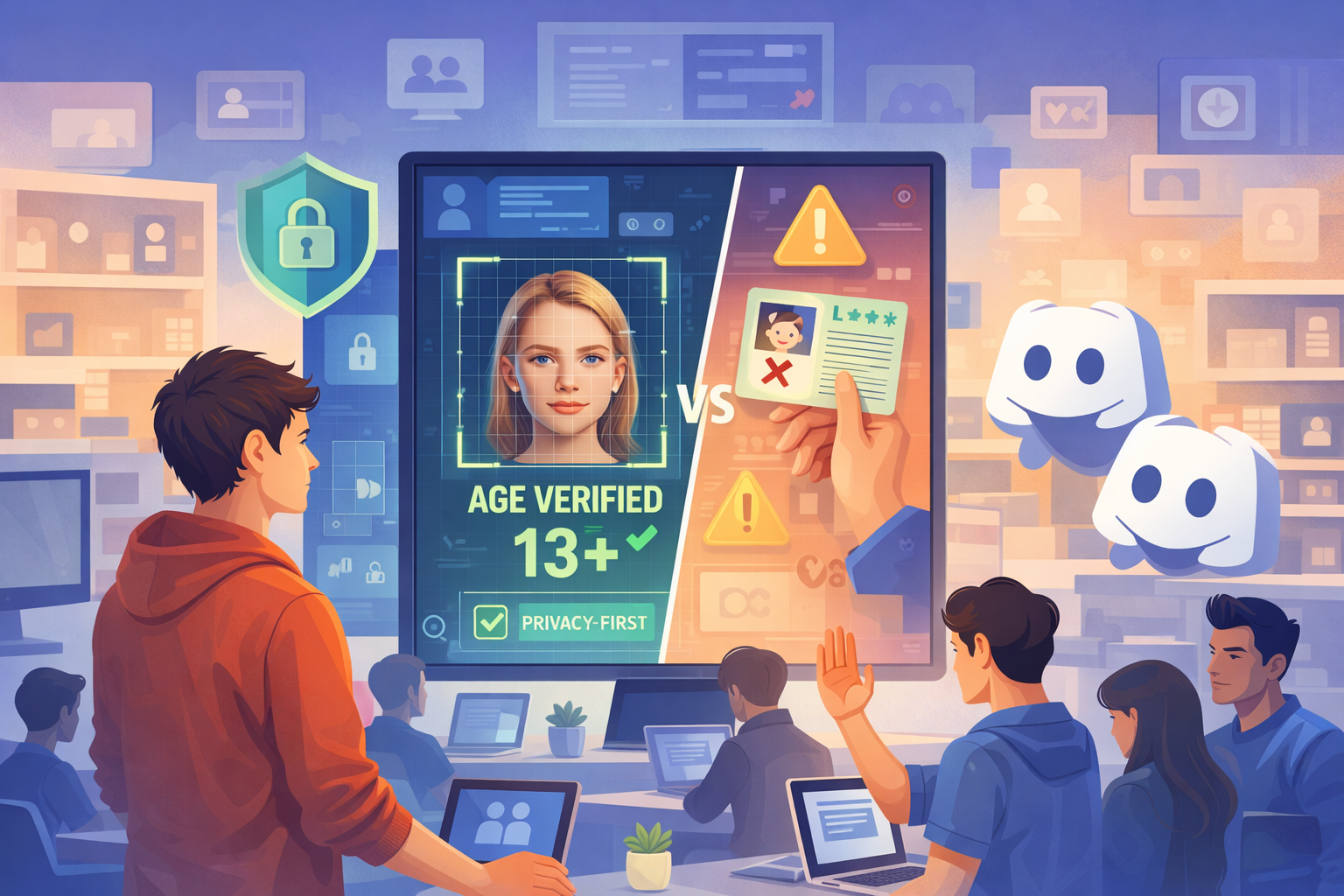
Age verification comes in many forms, but a clear trend is emerging across the industry: on-device age estimation is becoming the preferred model for privacy-preserving age checks.
Different methods of age verification
Each way of verifying age has different levels of friction and privacy protection. Some of the most common methods include:
Document-based verification - users upload an ID such as a passport or driving licence. This approach requires sharing highly sensitive personal information, which is stored by processors and subprocessors and is frequently subject to data leaks.
Payment or credit card checks - sometimes used as a proxy for age, but unreliable and exclusionary, particularly for younger adults who may not have payment cards.
Database or identity verification – this matches user information against external data sources. These solutions often require personal information to be shared with third parties and is subject to similar vulnerabilities around database leakage and misuse.
Facial age estimation – uses AI to anonymously estimate whether the face in front of the camera is above or below a specific age threshold based.
Facial age estimation is becoming increasingly attractive because it offers a fast, low-friction way to confirm age. But the way the technology is implemented differs among suppliers, with some implementations being more vulnerable to personal data leakage and abuse.
Ars Technica ran an article recently on facial age estimation and underscored the trend of ‘on-device’ age estimation becoming the preferred way of the industry to deliver privacy-by-design age estimation. It also highlighted the leadership of Privately’s on-device solution that delivers more than one million age checks every week across the globe.
The focus on ‘on-device’ solutions is pertinent given that other providers have faced allegations about facilitating government surveillance or keeping personal data for too long under (Article 5(1)(e) GDPR). Historically, these solutions have required users to upload an image to a remote server where the age estimation takes place. Even if the image were to be deleted immediately, it still passes through multiple systems during processing and creates many points of vulnerability. Ultimately, you are asking the user to simply trust that it won’t be stored and misused.
The privacy challenge facing age assurance
It would seem that many people aren’t willing to offer that trust, as public concern about biometric data is growing rapidly. Privately SA research in December 2025, revealed that just 13% of adults trust online platforms to protect biometric information such as facial images.
However, support rises sharply when privacy protections are guaranteed. Three times as many people would accept facial age-estimation if it were carried out entirely on-device, with images never leaving the device.
People are understandably cautious about where their facial images go, who has access to them, and how they might be used in the future.
What makes on-device age checks different
On-device age estimation addresses this by changing where the processing happens. Instead of sending an image to a server, the analysis takes place directly on the user’s own device.
The system temporarily accesses the camera, estimates the user’s age locally, and returns only a signal indicating whether the user meets the required age threshold.
Crucially:
- No facial images are uploaded
- No biometric data is stored
- No personal information is shared with platforms
- Only the result of the age check is communicated
A privacy-first future for age assurance
It’s becoming clear that solutions relying on collecting or storing sensitive biometric data risk undermining that trust. On-device age estimation offers a different approach: highly accurate age checks delivered without sharing or storing personal data.
As age assurance becomes more widely adopted across platforms and services, privacy-first solutions are not just preferable, they will become the industry standard.